Knowledge Gateway
Agent Alex: the librarian with clearance
Every cross-boundary knowledge request flows through Agent Alex. Alex evaluates clearance, resolves the query, and returns only what the requesting agent is permitted to see.
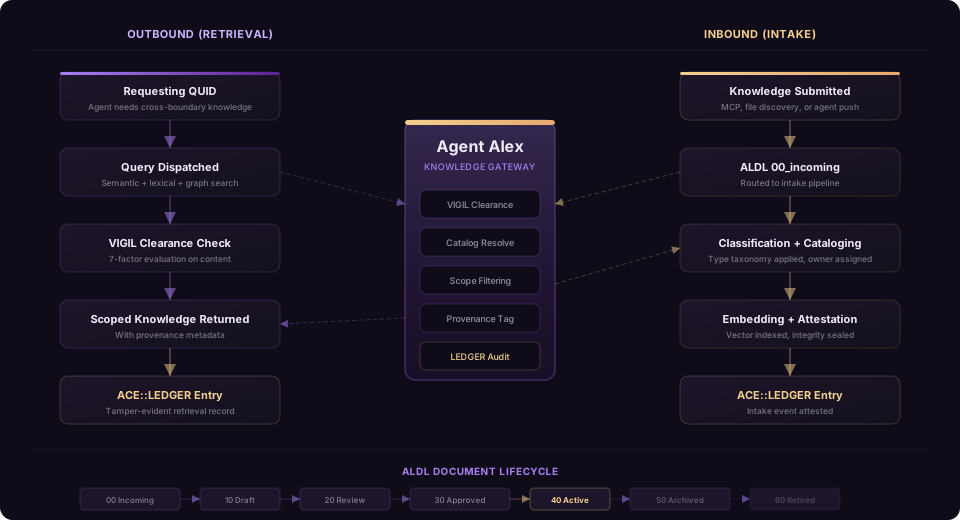
The LIBRARY Flywheel
LIBRARY is the governed knowledge layer for agentic systems. Deterministic discovery, policy-gated access, and a type taxonomy that prevents knowledge drift at scale.
The Problem
RAG without governance is a search engine with admin credentials. LIBRARY turns retrieval into a governed operation — scoped, attributed, and auditable.
Agent embeds everything. Retrieves across boundaries. No ownership model. No access control. Sensitive documents surface in unrelated contexts.
Every artifact has an owner, a scope, and a lifecycle stage. Cross-boundary access goes through Agent Alex. VIGIL gates the response. LEDGER records the retrieval.
LIBRARY doesn't restrict knowledge — it routes it. The right knowledge reaches the right agent at the right time, with the right clearance. Nothing more.
Ownership
All knowledge in ACE belongs to exactly one scope. Routing rules are deterministic — no heuristics, no guessing.
Runbooks, playbooks, SOPs that belong to a single project. Agents read locally — no LIBRARY call needed. Fast, implicit, zero overhead.
Location: <project>/docs/ops/
Standards, doctrine, governance rules, and taxonomy owned by LIBRARY. Cross-project queries go through Agent Alex with VIGIL clearance.
Location: core_reference/docs/standards/TOK/
Knowledge shared across projects for coordinated work — incident patterns, protocol specs, shared standards. Scoped views enforced by VIGIL.
Location: core_reference/.../initiatives/
Knowledge Gateway
Every cross-boundary knowledge request flows through Agent Alex. Alex evaluates clearance, resolves the query, and returns only what the requesting agent is permitted to see.
Lifecycle
The ACE Library Document Lifecycle (ALDL) manages artifacts from submission through active use to retirement. No orphaned documents. No stale knowledge.
Raw submission. Awaiting classification and cataloging. Source and submitter recorded.
Classified and typed. Under active development. Not yet discoverable by other agents.
Complete and awaiting review. Quality checks, accuracy verification, ownership confirmation.
Reviewed and approved. Ready for promotion to active use. Embeddings generated.
Discoverable. Retrievable. Governed. The knowledge is live and serving agent queries.
Superseded or no longer relevant. Retained for audit trail and historical reference. Not served to active queries.
Knowledge Promotion
Harvest mature, battle-tested knowledge from project-local docs. A runbook that survived production is worth more than a standard written in theory.
Attach gleaned knowledge to the platform-canonical layer with provenance intact. The project origin, author QUID, and promotion date are all recorded.
Promoted knowledge becomes discoverable across all projects. Agents in different contexts benefit from lessons learned elsewhere. The platform gets smarter.
Taxonomy
LIBRARY owns the canonical type taxonomy for all knowledge artifacts in ACE. Every artifact has a type. Every type has a schema. No "miscellaneous" bucket.
Knowledge that shapes how agents think and behave.
Knowledge that drives how agents act and respond.
Knowledge from HEAL — patterns deposited by every incident cycle.
Knowledge about knowledge. The rules that govern the library itself.
The Flywheel
Governed knowledge. Deterministic discovery. Compounding intelligence.