The Loop
Evidence builds trust. Trust unlocks autonomy. Autonomy generates evidence.
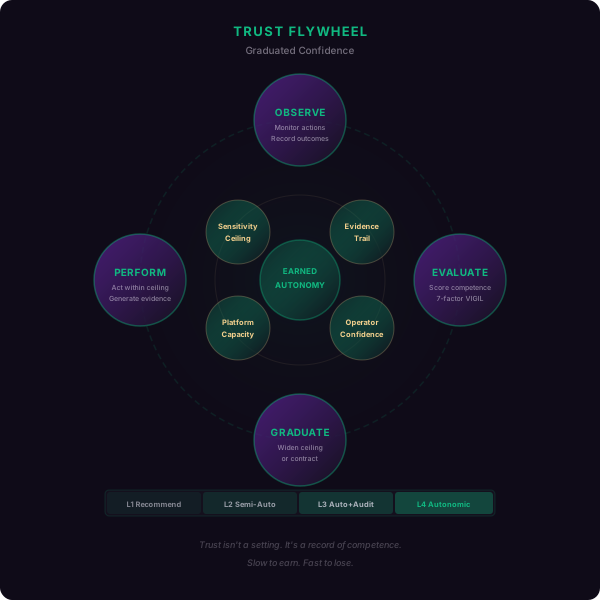
The Trust Flywheel
Most platforms ask you to trust agents on day one. ACE assumes zero trust and lets agents earn it. Every competent action builds the case for less friction — and the audit trail to prove it was the right call.
The Problem
Today's agent permissions are all-or-nothing. Full access or no access. That's not how you'd onboard a new employee — and it's not how you should onboard an agent.
Agent gets the developer's keys on day one. No ceiling. No inspection. One hallucination and it's writing to production, emailing customers, or leaking data through a side channel.
Every action requires human approval. The agent becomes a suggestion engine. Operators get alert fatigue. The value proposition collapses under the weight of friction.
Start restrictive. Observe competence. Widen the ceiling based on evidence. The agent earns autonomy the same way a new team member does — by demonstrating it.
The Loop
Autonomy Levels
Advancement isn't time-based. It's evidence-based. An agent that consistently demonstrates competence, stays within ceilings, and handles edge cases well earns the next level. An agent that doesn't, stays where it is.
Agent observes, analyses, and recommends. Every action requires operator approval. Full human oversight. This is where every agent starts.
Operator load: High
Agent autonomy: None
Evidence generated: Maximum
Low-risk actions execute without approval. High-risk actions still require HITL gate. The agent handles routine work; the operator focuses on judgement calls.
Operator load: Moderate
Agent autonomy: Scoped
Evidence generated: High
Agent acts autonomously within its ceiling. Full LEDGER audit trail. Operator is informed of actions, not blocking them. Exceptions escalate automatically.
Operator load: Low
Agent autonomy: Broad
Evidence generated: Continuous
Self-correcting within governed boundaries. Operator monitors trends and health, not individual actions. The agent has earned the ceiling it operates in.
Operator load: Minimal
Agent autonomy: Full (bounded)
Evidence generated: Ambient
Mechanics
Every boundary crossing is evaluated against seven factors: identity, capability, content sensitivity, destination trust, temporal context, provenance chain, and cumulative exposure. The composite score informs whether the action proceeds, escalates, or blocks.
Every action, approval, rejection, and escalation is recorded with tamper-evident attestation. The evidence trail is the objective basis for trust progression — not opinions, not time served, not vendor claims.
Sensitivity ceilings can only tighten during a session, never loosen. Between sessions, ceilings can be widened based on accumulated evidence. A single policy violation can contract the ceiling. Trust is asymmetric — slow to earn, fast to lose.
Outcomes
Approval fatigue disappears as agents earn autonomy for routine work. Operators focus on the decisions that actually need human judgement.
Every permission expansion is backed by an evidence trail. Auditors can see exactly why an agent has the access it has — and what it did with it.
EU AI Act Article 14 requires human oversight proportionate to risk. Graduated trust implements this structurally, not as a policy checkbox.
Agents that prove themselves get faster. The platform doesn't choose between speed and safety — it uses evidence to calibrate the right balance.
The Flywheel
HEAL deposits evidence of competent remediation. LIBRARY makes trust policies discoverable. AGENT x AGENT carries the governed conversations that generate evidence. Trust is the currency that connects them all.
Trust isn't a setting. It's a record of competence.